Camas Luxury Homes: A Hedonic and Structural Analysis of the View Premium
In Camas, a view is not a single amenity. It is a combination of orientation, permanence, engineering, legal protection, and the cost required to keep the house comfortable on an exposed site.

Camas sits fourteen miles east of Portland on the Washington side of the Columbia River. Its history begins, in civic terms, with the LaCamas Colony Company and the paper mill established in 1883. The city’s own history records Henry Pittock, publisher of The Oregonian, among the company’s founders. The mill shaped generations of local life; the Papermakers name still carries that history.
The economy around it is now broader. The City of Camas Housing Action Plan identifies Fisher Investments and WaferTech among the city’s largest private employers, while the U.S. Census Bureau estimates median household income at $141,126 for 2020–2024. Georgia-Pacific’s former mill property also remains the subject of a state-supervised environmental investigation under a 2021 Agreed Order. Camas is not a town without its industrial past. It is a community whose technology, financial-services, school, and residential economies now exist alongside that past.
That transition helps explain the depth of demand for high-quality housing. It does not, by itself, explain the value of a particular home.
At the upper end of the Camas real estate market, value often turns on a more exact question: what, precisely, can be seen from the property—and what will it take to preserve that experience?
A premium view is not simply scenery. It is a scarce property attribute whose value depends on composition, protection, engineering, and the absence of an easy substitute.
Why Camas has a view market
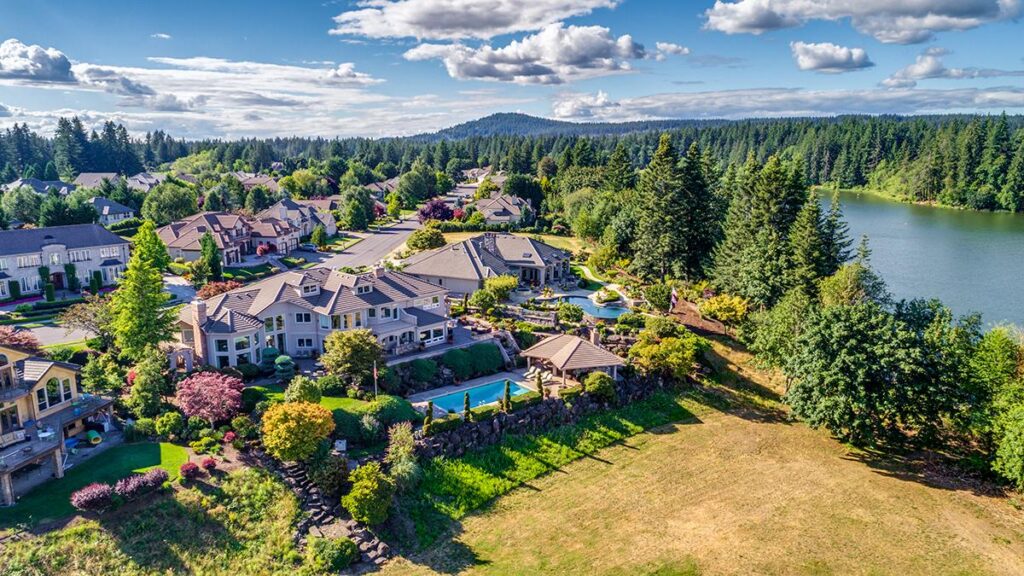
Topography creates the product. Prune Hill, the ridges above the Columbia, the edges of Lacamas Lake, and the newer elevations around Green Mountain produce sightlines that are unusually varied within a compact area. One home may frame the Columbia River, Portland lights, and Mount Hood. Another may look north toward Lacamas Lake, Mount St. Helens, or wooded Cascade foothills.
Those are not interchangeable experiences. Morning light, afternoon glare, winter cloud cover, traffic noise, exposure to wind, the location of neighboring rooflines, and the rooms from which the view is visible can matter as much as the named landmark in a listing description.
This is why broad citywide medians are a weak valuation tool for distinctive properties. They describe the environment around a sale, not the contributory value of its lot, orientation, architecture, or view corridor.
The fiscal context: relevant, but not a shortcut
Camas is part of one metropolitan economy divided by a state line. Tax differences can influence where executives, business owners, and other high-income households choose to live, but the comparison is more nuanced than “move across the river and save a fixed percentage.” Residency, source of income, filing status, entity structure, and future law all matter.
Personal income tax
Different current structures
Oregon’s top state marginal rate is 9.9%. Portland-area households may also encounter Metro Supportive Housing Services and Multnomah County Preschool for All taxes above applicable thresholds. Washington does not currently impose a broad individual income tax; a 9.9% tax on adjusted gross income above $1 million is scheduled to begin in 2028.
General sales tax
Consumption is treated differently
Oregon has no general sales tax. The combined retail sales-tax rate in Camas is 8.8% for the third quarter of 2026, according to the Washington Department of Revenue.
Capital gains
Real estate has a state exemption
Washington’s capital-gains excise tax uses 7% and 9.9% tiers for taxable long-term gains, but transfers of real estate are excluded under chapter 82.87 RCW. That state exemption does not remove federal tax, depreciation, entity, or other obligations.
Property assessment
Different holding-cost behavior
Oregon’s Measure 50 generally limits annual growth in maximum assessed value to 3%, absent qualifying property changes. Clark County revalues real property annually at 100% of true and fair market value. Neither system can be compared reliably from the tax rate alone.
The practical conclusion is modest: state and local tax structure can be an important part of a household’s location decision, and some households may redirect part of a tax difference into housing. It is not a universal subsidy, and it should be modeled with qualified tax and legal advisers before a purchase.
Hedonic pricing: what the research can—and cannot—tell us
Hedonic pricing treats a house as a bundle of characteristics. A statistical model attempts to separate the contribution of living area, age, condition, lot, location, schools, and amenities such as a view. In theory, the result is an implicit price for each attribute.
A frequently cited Pacific Northwest study by Earl Benson and his co-authors analyzed more than 20,000 home sales in Bellingham, Washington. After controlling for other characteristics, the authors found large differences between full, superior, partial, and poor ocean views; lake frontage and lake views also carried premiums. The strongest view category in that market was associated with an estimated premium approaching 59%, while the weakest ocean-view category was roughly 8%.
Those figures are useful because they prove that buyers distinguish between view quality. They are not a Camas appraisal adjustment. The study concerned another city, another period, and another set of properties. Applying its percentages directly to a Prune Hill home would create false precision.
For a Camas property, the reliable approach is local paired-sales analysis: compare recent sales that are genuinely similar in location, site, quality, condition, and timing, then study what remains different. Even then, a view adjustment is a reasoned market conclusion, not a fixed tariff.
How I analyze a Camas view
Composition
Water, mountain, skyline, territorial depth, and night lighting create different experiences. A layered Columbia–Portland–Mount Hood composition may be more difficult to substitute than a broad but undifferentiated territorial view.
Breadth and clarity
A protected panoramic sightline is different from a narrow glimpse between roofs. Vegetation, utility infrastructure, haze, and seasonality should be evaluated from the principal living spaces.
Permanence
Zoning, recorded easements, CC&Rs, vacant downhill parcels, and the likely mature height of nearby trees all influence whether today’s view will remain tomorrow’s view.
Daily livability
The most valuable sightline is usually integrated into the kitchen, great room, primary suite, and outdoor living areas—not confined to a landing, upstairs bedroom, or seasonally uncomfortable deck.
Exposure and comfort
Wind, western solar gain, glare, privacy, and exterior noise can offset some of the visual benefit. Glass specifications, shading, landscaping, and mechanical design shape the lived result.
Replaceability
The central valuation question is how many reasonable substitutes exist at the same time. A rare view on a usable lot with strong architecture behaves differently from a dramatic view attached to a compromised house.
Prune Hill is not one market
Prune Hill is often discussed as though it were a single luxury submarket. It is better understood as a series of orientations and elevations.
Southern and southwestern exposure
River, skyline, and Mount Hood
Well-positioned homes may combine moving water, Portland lights, and a volcanic peak in a single composition. The same exposure can introduce stronger gorge winds, afternoon solar load, and the engineering demands of steeper sites.
Northern and northeastern exposure
Lake, mountain, and territorial calm
Other homes orient toward Lacamas Lake, Mount St. Helens, wooded ridges, or Cascade foothills. The experience may be quieter and greener, with a different light pattern and a different set of comparable sales.
Neither direction is universally superior. A buyer who values evening city lights may make a different choice from one who wants morning light, lake access, or a wooded outlook. The premium belongs to the buyer pool for that specific product.
The physical cost of the view
Some of the price difference between a view property and a flat-site home reflects the cost of creating a safe, durable building—not merely a seller’s markup.
Steep ground can require geotechnical investigation, specialized foundations, careful grading, slope stabilization, stormwater controls, and engineered retaining structures. The City of Camas generally requires permits for retaining walls more than four feet high and for walls supporting a surcharge; structures over six feet require additional director approval. Southern Prune Hill also contains documented steep and potentially unstable terrain, making site-specific investigation important.
Large openings add another layer. View homes often use expansive glazing and multi-panel doors precisely where wind and wind-driven rain can be most demanding. A window’s design-pressure rating expresses tested resistance to structural load, water, and air infiltration. DP50, for example, refers to a 50-pound-per-square-foot design pressure and a higher structural test pressure. It should not be translated into one universal “miles per hour” claim because building height, exposure category, opening location, component size, and local code criteria all affect the required specification.
The right question is not whether a house has “high-end windows.” It is whether the architect, engineer, builder, and product manufacturer selected assemblies appropriate for that exact site and opening size—and whether installation records, flashing, maintenance, and warranty history support the claim.
Solar control matters too. A wall of west-facing glass can turn an extraordinary sunset into an uncomfortable room without suitable coatings, exterior shading, automated interior shades, or mechanical capacity. The best view homes make the panorama effortless to live with.
The legal scaffolding: what actually protects a sightline
A view can be visually obvious and legally fragile. Buyers should distinguish among four different forms of protection:
- Recorded view easements. A carefully drafted easement may restrict structures or vegetation within a surveyed corridor on another parcel. Its language, beneficiaries, enforcement provisions, and title priority require legal review.
- HOA covenants and architectural rules. Some communities regulate tree height, structures, or landscaping. Rules are only as useful as their text, amendment history, consistent enforcement, and financial ability to enforce them.
- Municipal zoning. Camas single-family zones R-6 through R-15 generally use a 35-foot maximum building height, with lot-coverage limits that vary by district. Those controls shape massing, but they do not guarantee an individual owner’s view.
- Practical site conditions. Public land, roads, mature development, steep slopes, and already-built neighboring homes may make obstruction less likely. That is practical durability, not the same as an enforceable property right.
A 2024 Washington Court of Appeals decision involving View Ridge Estates in Camas illustrates both the strength and the limits of covenants. The association’s restated declaration restricted vegetation in defined view corridors to 15 feet—or the first-story gutter height, whichever was lower—and six feet between homes. The court upheld the amendment because the original declaration already addressed views and joint enjoyment, and the required supermajority had approved the change.
The decision does not give every HOA unlimited authority over every tree. It is a fact-specific interpretation of that community’s recorded documents and amendment process. Buyers should obtain the complete declaration, amendments, architectural rules, enforcement history, meeting minutes, and any pending disputes, then review them with counsel.
View and assessed value
Clark County assesses real property annually at 100% of true and fair market value. A view can therefore be one of the characteristics considered when selecting comparable sales and reconciling value.
If an assessment appears to rely on homes with materially better sightlines, a property owner may petition the Clark County Board of Equalization. The county’s own guidance emphasizes clear, convincing market evidence: comparable sales, photographs, maps, appraisals, and documentation of property characteristics. A successful appeal is not guaranteed, and an owner must establish the property’s market value—not simply show that the assessment increased.
The disciplined argument is specific: the comparable has a protected 180-degree water view, while the subject has a seasonal opening filtered by structures and vegetation. Vague claims that the view is “not as good” are much less useful.
Four Camas micro-markets, four different products
Dawson’s Ridge
Custom ridge architecture
The 2019 NW Natural Parade of Homes brought regional attention to this southwest Camas setting. Its appeal is the combination of custom construction, controlled neighborhood presentation, and broad Columbia-facing elevations. Scarcity can be meaningful, but so can a smaller buyer pool for highly individualized homes.
Columbia Palisades
Land plus a construction problem
Here, a buyer may be valuing a finished home or the opportunity to create one. Lot orientation, geotechnical conditions, retaining, utility status, architectural review, and the total cost to reach a finished result are inseparable from the view.
Lacamas Shores
Waterfront and lake orientation
Direct frontage, dock rights, shoreline rules, riparian conditions, privacy, and water access introduce a different diligence set from an elevated territorial view. A lake relationship is not interchangeable with a distant lake glimpse.
Green Mountain and The Glades
Engineered newer construction
Newer neighborhoods may offer mountain or territorial outlooks with contemporary systems and lower immediate renovation burden. SHAWOOD’s Glades community, for example, uses a proprietary post-and-beam structural system. Buyers still need to evaluate future phases and what can be built in the foreground. We look more closely at how individual Clark County communities compare elsewhere in the journal.
These areas should not be reduced to fixed online price bands. Inventory changes, custom quality varies, and an individual lot can materially outperform—or underperform—the neighborhood label. Current active competition and recent closed sales should be reviewed at the time of the decision.
A buyer’s view-premium diligence list
- Visit in the morning, late afternoon, after dark, and, when possible, during poor weather.
- Photograph the sightline from the rooms and outdoor areas where daily life will actually occur.
- Identify every parcel, roofline, and major tree within the view corridor; review vacant land and pending development.
- Obtain title materials, recorded easements, CC&Rs, amendments, architectural rules, and relevant HOA minutes.
- Review geotechnical reports, drainage plans, retaining-wall permits, structural drawings, and known slope repairs.
- Confirm window and door product information, design-pressure ratings, installation records, leak history, and warranties.
- Study heating and cooling performance, shade strategy, deck usability, wind exposure, and exterior maintenance access.
- Ask an appraiser or broker to support the view adjustment with local market evidence rather than a national percentage.
For sellers: prove the view, do not merely announce it
A view should be documented with the same discipline as square footage or renovation history. Photography needs to show the relationship between interior space and landscape, without misleading lenses, artificial sky replacement, or saturation that creates a scene the buyer will not experience.
Floor plans can identify which rooms receive the view. Aerial imagery can explain elevation, surrounding development, and proximity to the river or lake. Twilight photography is useful when city lights or outdoor lighting are part of the product. Seasonal photographs may be appropriate when deciduous vegetation materially changes the sightline.
Just as important, sellers should assemble the evidence behind durability: survey materials, easements, HOA documents, permitted engineering work, glazing specifications, drainage maintenance, and improvements made to manage solar exposure or wind. That package turns “beautiful view” from a marketing adjective into a more understandable property attribute.
Pricing should then reflect the whole home. A superior panorama does not erase a compromised floor plan, difficult driveway, obsolete systems, excessive exterior maintenance, or an ambitious renovation requirement. Conversely, a well-designed, well-documented property with a rare and protected view may deserve comparison beyond the nearest streets.
The view premium is a durability question
Camas luxury real estate sits at the intersection of unusual topography, metropolitan migration, evolving tax law, custom architecture, and scarcity. The view is the most visible part of that equation, but not the only part.
What buyers are really purchasing is an experience: the composition seen from the main rooms, the confidence that it will remain, the comfort of living with the exposure, and the quality of the home attached to it.
That is why the view premium cannot be captured by one percentage. It must be built from the property outward—using local sales, site evidence, engineering records, legal documents, and the availability of true substitutes.
For a broader look at the areas surrounding Camas, explore Oksana’s guide to Clark County communities, read A Morning in Camas, or review the latest market perspective.