Buying · Acreage
Buying Acreage in Clark County: 8 Things to Verify Before You Write an Offer
Buying acreage in Clark County, WA means buying more than a house. You are acquiring the land, the water source, the septic system, the access rights and the environmental conditions that make the property work. This is what to verify before the offer, not after.
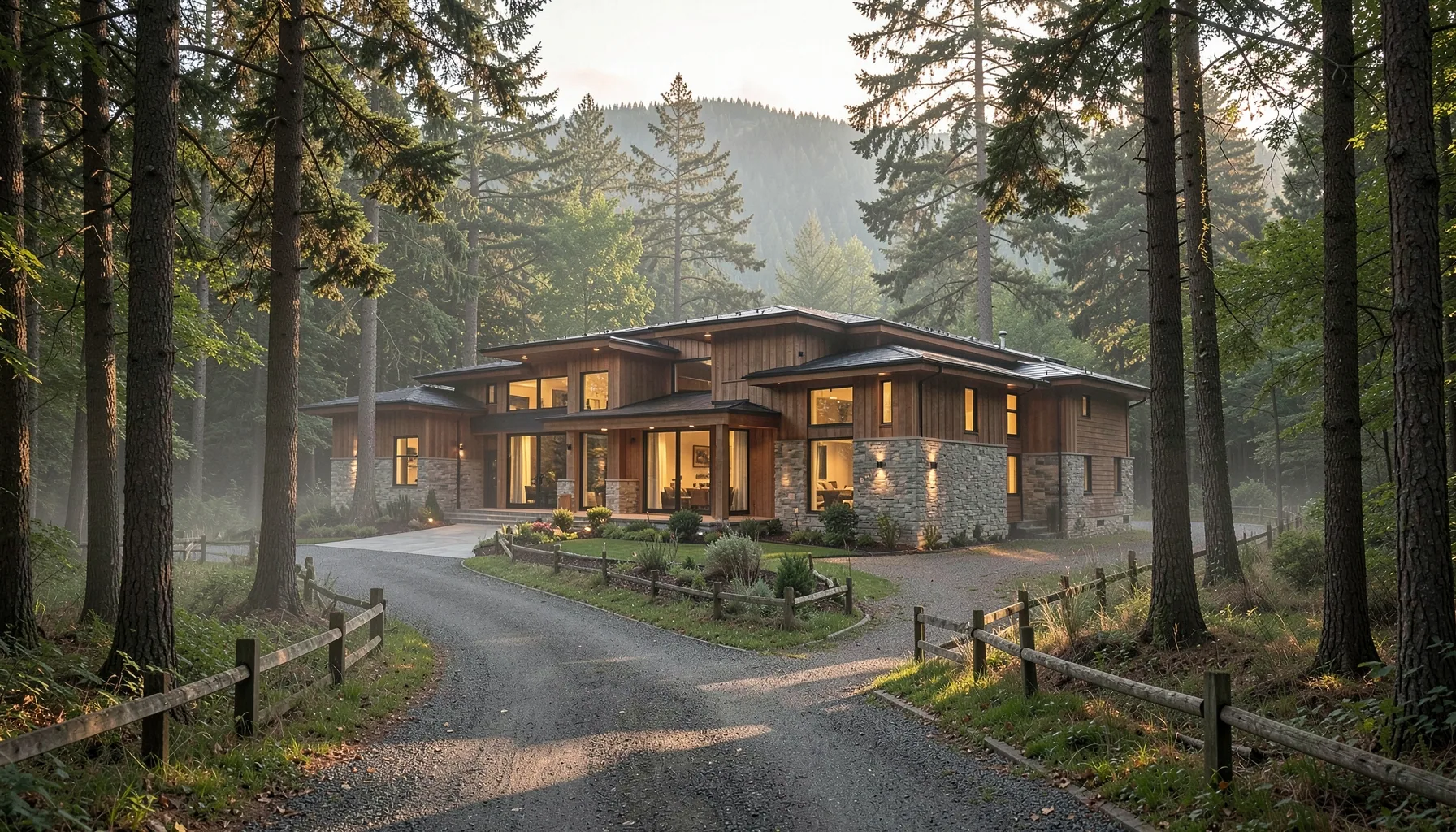
A conventional home in a Ridgefield or Salmon Creek subdivision comes with public water, public sewer, recorded utilities and a lot whose boundaries and building envelope have already been engineered for you. Acreage rarely does. In Brush Prairie, Hockinson, Felida, rural Camas and the quieter edges of greater Vancouver, the residence usually sits on top of private infrastructure and natural conditions that a standard showing simply cannot reveal.
That is what makes buying acreage in Clark County a different exercise. You are underwriting a private well or a shared one, an on-site septic system, a driveway that may cross someone else’s land, and acreage that is almost never entirely usable. About 35,000 homes and businesses in Clark County rely on septic systems rather than public sewer, and a large share of rural parcels draw their water from private wells. Each of those systems has records, a history and a capacity that can be verified in advance.
None of this is a reason to avoid rural property. It is a reason to look in the right places before you commit. The eight checks below, followed by a practical order of operations, are how a serious acreage buyer moves from an appealing listing to a property they actually understand.
Private Water
Most rural parcels rely on an individual well, a shared well or a small Group B system rather than public water. Depth, production and quality vary well to well, and clear running water at a showing proves none of it.
On-Site Septic
Roughly 35,000 Clark County properties treat their own wastewater on site. The permit, the as-built drawing, the drainfield location and the inspection history are all part of what you are buying.
Usable vs. Total
Parcel size is not developable size. Wetlands, slopes, flood areas and habitat buffers can quietly remove the exact corner where you pictured a shop, a barn or a guest house.
Access & Rights
A beautiful driveway is not the same as a legal, maintained right of way. Easements, shared roads and maintenance duties are recorded documents worth reading before you offer.
1. Confirm exactly where the water comes from
The first question on any acreage property is the most basic one: where does the water come from, and can that source be verified? Rural Clark County homes are typically served by an individual private well, a shared well used by two or more households, a small community or Group B water system, or, closer in, a public utility. Each arrangement carries different obligations, and the differences matter long after closing.
For a private well, you want to understand its depth, its age, its construction and how much water it actually produces. Washington keeps this on record. The Washington State Department of Ecology’s Well Report Viewer lets you search by map or by partial owner name or address and view the well log a licensed constructor filed, including location, construction details, the subsurface materials encountered and the quantity of water the well produced when it was drilled. Clark County Public Health also maintains well information through its GIS mapping, where you can look up well tag, depth and system classification for a documented well.
Production on paper is only part of the story. Water quality is a separate question, and it is one you resolve with testing, not observation. The Washington State Department of Health recommends that private well owners test every year for coliform bacteria and nitrate, the two contaminants that can affect health quickly. If a nitrate result comes back at 5 milligrams per liter or higher, the state suggests re-testing in six months. For arsenic, which occurs naturally in parts of the Pacific Northwest, the department advises testing at least twice during your ownership, once in summer and once in winter, to catch seasonal variation.
Clear, good-tasting water at a Sunday showing tells you almost nothing. Water quality and long-term production are established by records and testing, not by turning on a tap.
If the well is shared, the arrangement should be governed by a recorded shared-well agreement. Read it. A good agreement spells out who owns the well, how water is allocated, who pays for power and pump maintenance, and how repairs and eventual replacement are handled. Its absence is not automatically a dealbreaker, but it is a question to raise before you are contractually committed rather than after a pump fails.
2. Treat the septic system like a major property component
On acreage, the septic system deserves the same attention as the roof or the foundation, because replacing or expanding one is a comparable expense. Start with the paper. Clark County keeps septic permits, as-built drawings and inspection history on file, and you can reach them through the county’s Property Information Center: search by address or tax account number, then open the Environmental tab to view the permit, the as-built and prior inspection reports.
Those records tell you what kind of system you are buying and where it lives. You want to know the system type, its age, the location of the tank and the drainfield, and whether the parcel has a designated reserve area set aside for a future replacement drainfield. The reserve area matters more than buyers expect: if you intend to add a shop, a pool or an addition, you cannot build over the drainfield or its reserve, and that constraint can reshape where future improvements are even possible.
Clark County Public Health also connects septic to the sale itself. The county states that a current Report of System Status should be on file before a home is listed, and it treats that report as current when it was completed within one year of the date of sale. The report follows an inspection, and inspection frequency depends on the technology:
Conventional and pressure systems
Clark County calls for a conventional gravity system to be inspected every three years, and a pressure distribution system every two years. These are the most common designs on older rural parcels.
Advanced treatment systems
Sand filters, sand mounds, aerobic treatment units and similar advanced systems are called for annually, as are systems serving food establishments, because they have more components that can fall out of adjustment.
Ask whether the required inspections have actually been performed and whether the results are on file. A gap in the record is not proof of a problem, but it is exactly the kind of thing to investigate during your inspection window, when you can still act on what you learn.
3. Make sure the home’s use matches the permits
Rural homes evolve. Over the decades a property is owned, lower levels get finished, garages become living space, shops gain plumbing, detached buildings turn into guest quarters, and rooms get described as bedrooms. Most of this is ordinary and well-intentioned. The point of diligence is not to assume anything is wrong, but to confirm that what exists today matches what the county has on record.
You can compare the two yourself. Through the Property Information Center and MapsOnline, Clark County publishes building and development permit history for a parcel, drawn from its permitting systems, along with zoning and other parcel data. Walk the property with that history in hand and note where the physical reality and the permit record diverge: an added bedroom, a converted garage, a shop with a bathroom, a second dwelling, a deck or an addition.
Discrepancies are common and usually resolvable, but they are worth surfacing early because they can affect financing, insurance, appraised value and what you are allowed to do next. A finished space that was never permitted as a bedroom, for example, may not count toward the home’s official bedroom count, which can matter both to a lender and to septic sizing. This is normal due diligence, not an accusation, and it is far easier addressed before an offer than during escrow.
4. Separate total acreage from usable acreage
A ten-acre parcel is not ten usable acres. The figure on the listing describes the boundary, not the buildable land inside it, and on acreage the gap between the two is often where the value question actually lives. Clark County regulates development around designated critical areas, and its Critical Areas Ordinance, adopted under the state Growth Management Act, addresses five categories:
- Wetlands, regulated to protect wetland functions, typically with buffers around the wetland itself.
- Fish and wildlife habitat conservation areas, including streams, riparian corridors and protected habitat.
- Geologically hazardous areas, covering steep slopes, landslide, seismic and volcanic hazards.
- Flood hazard areas, where development is limited to protect health and safety.
- Critical aquifer recharge areas, which protect the groundwater that many rural wells depend on.
Where a critical area exists, the county generally requires a buffer or setback around it, and that protected land is removed from your practical building envelope even though you still own it and still pay taxes on it. This is exactly the constraint that surfaces when a buyer wants to add a shop, a pool, a barn, a riding arena, a detached garage, a guest house, an addition or a second residence. The parcel may be large and the improvement modest, yet the one flat, well-drained corner that would suit it may sit inside a wetland buffer or a steep-slope setback.
A critical area is not a defect. Streams, wetlands and wooded slopes are often the very features that make a rural property worth owning. The goal is simply to know where they are and what they permit before you assign value to land you may not be able to use the way you imagined.
5. Verify zoning before pricing “potential”
Few phrases cost acreage buyers more than “you could probably build another house here.” Sometimes it is true. Often it is not, and the difference is not a matter of opinion, it is a matter of code, capacity and mapping that can be checked before you pay for the possibility.
Before you assign real value to a future use, confirm the zoning and comprehensive-plan designation, any applicable overlays, the required setbacks under Clark County’s Title 40 Unified Development Code, whether utilities and legal access exist, whether the septic system and soils can support additional capacity, and any environmental restrictions on the buildable area. The county’s property research tools report the parcel’s zoning and let you reach the applicable code, and a call to Clark County Community Development can confirm how a specific rule applies to a specific parcel.
The uses buyers most often ask about are the ones most worth verifying: a detached shop, an accessory dwelling unit, livestock or horses, a home business, an additional residence, or dividing the parcel. Each has its own requirements, and none is guaranteed by lot size alone.
Why the neighbor’s setup is not your permit
It is tempting to reason from the property next door. Be careful. A neighboring parcel may carry different zoning, a different comprehensive-plan designation, grandfathered rights established under older rules, permits you cannot see from the road, or lot conditions that simply do not exist on the property you are buying. What your neighbor was allowed to build tells you very little about what you will be allowed to build. Verify the parcel in front of you, on its own record.
6. Understand the access, not just the driveway
Every acreage property has a driveway. Not every acreage property has clean, recorded, maintained legal access, and the two are easy to confuse. Many rural parcels reach the public road across a private road, a shared driveway or an access easement over a neighbor’s land, sometimes crossing a bridge or a culvert that someone is responsible for maintaining.
These arrangements live in the title, not in the landscaping. A preliminary title report and the recorded easements it references will tell you what legal right provides access to the property, who else is entitled to use it, and who is obligated to maintain it. A recorded road-maintenance agreement, where one exists, sets out how costs are shared for grading, gravel, snow, a shared gate or a failing culvert. Where no agreement exists, those costs and decisions can become a source of friction between neighbors.
The question to answer before you offer is simple to say and worth insisting on: what legal right provides access, who else can use it, and who is responsible for maintaining it?
7. Look below the beauty of a wooded or sloped site
The features that make a Camas hillside or a creek-side Hockinson parcel beautiful, the grade, the trees, the water, are the same features that ask for a closer look. Steep slopes, drainage patterns, erosion, potential landslide hazards, retaining walls, hillside foundations, wooded ground and creek-adjacent land can all be genuine amenities and still carry engineering and maintenance considerations that a level subdivision lot never would.
Clark County maps geologically hazardous areas, including steep slopes and landslide hazards, and its GIS layers can show you contour and elevation data for a parcel. Use them as a first screen, not a final answer. A hazard shown on a county map is a prompt to ask a qualified professional, and a hazard absent from the map does not certify a slope as stable. Where grade, drainage or a planned addition raises real questions, the appropriate expert is a geotechnical or civil engineer, not a mapping tool. Driveway grade deserves its own thought, since a long, steep approach affects daily use, drainage and winter access.
8. Check flood exposure and drainage separately
Flood risk on acreage is really two questions, and buyers often answer only the first. The first is mapped flood risk: whether the parcel falls within a FEMA or county special flood hazard area. Clark County’s flood mapping is built around the base flood, defined as the flood that has a one percent chance of being equaled or exceeded in any given year, the standard often called the 100-year floodplain. You can look a parcel up through FEMA’s Flood Map Service Center or the county’s Flood Insurance Rate Maps, and the answer affects flood insurance and what you may build in the mapped zone.
The second question is drainage, and no map fully answers it. Seasonal water, runoff from higher ground, the behavior of a creek in a hard January rain, the condition of culverts, a driveway that pools, a low corner that holds water, a pond that rises and falls, are all local realities that a parcel can have while sitting entirely outside a mapped flood zone. Being outside the special flood hazard area is genuinely good news for insurance and permitting. It is not a promise that water will never be a factor on the land. Walk the property with its wet season in mind, and ask how it drains when the weather is at its worst, not its best.
The acreage buyer’s order of operations
Diligence on a rural property goes more smoothly in sequence than all at once. Each step below informs the next, and moving roughly in this order helps you spend inspection dollars only where the records suggest they are warranted. Treat it as a working checklist for any acreage property you are taking seriously.
- County property records — pull the parcel’s basics through the Property Information Center and MapsOnline.
- Permit history — review building and development permits for the home and any outbuildings.
- Water source — confirm whether the property is on a private well, a shared well, a Group B system or public water.
- Well records — locate the well log through Ecology’s Well Report Viewer and note depth, construction and production.
- Water-quality information — obtain recent testing or arrange it for coliform bacteria, nitrate and arsenic.
- Septic permits and as-builts — open the Environmental tab to view the permit, system type and drainfield location.
- Septic inspection records — check that required inspections are current and that a Report of System Status exists.
- Preliminary title — order the prelim to see what the title actually shows.
- Easements — read every recorded easement, especially those governing access.
- Zoning — confirm zoning, comprehensive-plan designation, overlays and setbacks for the parcel.
- Critical-area mapping — identify wetlands, habitat, slopes and aquifer recharge areas and their buffers.
- Flood mapping — determine whether any part of the parcel sits in a mapped flood zone.
- Property inspection — complete a thorough general inspection of the residence and structures.
- Specialist inspections — bring in well, septic, geotechnical, structural or survey professionals where the records point.
The thread running through all fourteen steps is a single question: does the land, and do the systems that serve it, actually support the reason you are buying this property? A parcel bought for horses, a shop, a second home or simple privacy is only as good as the well, the septic, the access and the buildable land that make that vision possible.
How acreage differs around Clark County
“Acreage in Clark County” describes several distinct kinds of property, and the character of the land shifts noticeably from one part of the county to another. These distinctions are about the nature of the parcels, not a ranking of the communities.
Brush Prairie and Hockinson
North and east of Vancouver, Brush Prairie and Hockinson are where the county’s custom estates and larger wooded parcels concentrate: privacy, room for shops and outbuildings, equestrian potential and a genuine rural atmosphere within a reasonable drive of Camas and Vancouver. The trade-off is that nearly everything here runs on private well and septic, which makes the checks above central rather than optional. Our companion piece, the quiet case for acreage in Brush Prairie, looks at the appeal of these properties in more depth.
Ridgefield
Ridgefield blends established rural properties and working land with newer residential development, so acreage here ranges from long-held farm parcels to homes on a few acres near growing neighborhoods. The mix means water, sewer and zoning can vary considerably from one property to the next, which makes parcel-specific verification especially valuable.
Felida and Salmon Creek
Closer to Vancouver, Felida and Salmon Creek can offer larger homesites while keeping services, shopping and commuting routes close at hand. Parcels here are often smaller than the deep rural estates farther out, and some properties enjoy public utilities, so confirming exactly what serves a given lot is the first order of business.
Camas and East Clark County
Toward Camas and the eastern edge of the county, wooded and hillside properties come into their own, and with them the questions of view, topography, drainage and access become particularly important. A stunning site on a slope is a pleasure to own and a parcel where grade and stormwater deserve early, careful attention.
Across all of them, the underlying communities and how they fit together are worth understanding on their own terms; our overview of Clark County communities is a useful place to start, and the Waterfront & Acreage Buyer’s Guide goes further on the diligence that sets rural and water-adjacent property apart.
The most valuable acreage is acreage you understand
None of these checks exist to talk anyone out of rural property. Done well, an acreage purchase in Clark County is among the most rewarding a buyer can make, offering privacy, land and possibility that simply do not exist closer in. The purpose of diligence is to make sure that what you own matches what you thought you were buying: a sound water source, a septic system with a future, legal and maintained access, and land you can actually use for the reason you fell for the property.
The most valuable acreage, in the end, is acreage you understand. Verify the well, the septic, the access, the zoning and the buildable land, and a rural property stops being a hopeful guess and becomes a decision you can make with confidence.
A property-specific review before you write the offer
If you are considering an acreage, custom or rural estate in Brush Prairie, Hockinson, Ridgefield, Camas or greater Clark County, a property-specific review can help identify the records and questions worth resolving before you write an offer, from wells and septic to access, zoning and usable land.
Frequently asked questions
Do homes with acreage in Clark County usually have septic systems?
Yes. Most rural acreage properties in Clark County are served by an on-site septic system rather than public sewer. About 35,000 homes and businesses in the county treat their wastewater on site, and outside the sewered urban areas that share rises sharply. Confirm the system type, age and location through the county’s septic records early in your diligence.
How do I find septic records for a Clark County property?
Use the Clark County Property Information Center. Search by street address or tax account number, then open the Environmental tab to view the septic permit, the as-built drawing showing tank and drainfield locations, and prior inspection reports. Clark County Public Health also asks that a current Report of System Status, completed within one year of sale, be on file before a home is listed.
How can I research a private well in Clark County?
Start with the Washington State Department of Ecology’s Well Report Viewer, which lets you search by map or by owner name or address and view the well log, including depth, construction and the water quantity recorded when the well was drilled. Clark County Public Health also provides well tag, depth and classification information through its GIS mapping. Pair the records with current water-quality testing.
Can I build a shop or ADU on acreage in Clark County?
Sometimes, but never assume it based on lot size alone. Whether you can add a shop, an accessory dwelling unit, a barn or a second residence depends on the parcel’s zoning, comprehensive-plan designation, setbacks under Title 40, available septic capacity, legal access and any critical-area buffers on the buildable land. Verify each with Clark County Community Development for the specific parcel before assigning value to the possibility.
How do I know whether acreage is in a floodplain or wetland?
Check two separate sources. For flood risk, look the parcel up through FEMA’s Flood Map Service Center or Clark County’s Flood Insurance Rate Maps to see whether it falls in a mapped special flood hazard area, the one-percent-annual-chance floodplain. For wetlands and other sensitive land, review the county’s critical-areas mapping. Both are screening tools; on-site evaluation confirms what the maps suggest.
What should I inspect when buying acreage in Clark County?
Beyond a thorough general home inspection, plan for the systems and land a subdivision home does not have: the well and its water quality, the septic system and its inspection history, recorded access easements and title, zoning and setbacks, critical-area buffers, flood mapping and, where grade or drainage raises questions, a geotechnical or structural specialist. Let the records guide which specialists you actually need.
How much of an acreage parcel is actually usable?
It varies widely, because total acreage and usable acreage are not the same. Wetlands, streams and their buffers, steep slopes, flood hazard areas and habitat protections can all remove land from your practical building envelope while remaining part of the parcel you own. Reviewing the critical-areas mapping and setbacks for a specific property is the only reliable way to know how much of it you can truly use.
Sources and where to verify
The regulatory details in this article are drawn from current primary sources. Verify any specific requirement against the relevant county department for the parcel you are considering, since rules and records are updated over time.
- Clark County Public Health, On-site septic systems (inspection intervals, Report of System Status, records).
- Clark County Public Health, Drinking water and wells.
- Washington State Department of Ecology, Well Report Viewer.
- Washington State Department of Health, Testing your water.
- Clark County Community Development, Property research and records.
- Clark County, Critical areas ordinances.
- Clark County Public Works, Flood insurance rate maps, and FEMA Flood Map Service Center.
Disclaimer
This article provides general real-estate information and is not legal, engineering, environmental, septic, water-quality or land-use advice. Regulatory details, inspection intervals and records described here reflect current Clark County and Washington State sources at the time of writing and are subject to change. Property-specific questions should be verified with the appropriate county department and qualified professionals. Oksana Berezhnoy is a licensed real estate broker, not an attorney, engineer, surveyor, septic professional or water-quality expert. Oksana Luxury Homes is committed to equal housing opportunity. Photography is representative Pacific Northwest imagery and does not depict a specific property or listing unless expressly identified.