Buying · Clark County Waterfront
Waterfront vs. Water View: Why the Difference Matters to Value
Two Clark County homes can look toward the same stretch of the Columbia River and belong to entirely different real-estate categories. The distinction is worth making before anyone talks about price.

One home may own shoreline frontage. Another may sit several hundred feet uphill with a panoramic view and no frontage at all. A third may have no frontage but hold a recorded right to reach the water through a shared easement or community access. All three might describe themselves, honestly enough, as being “on the river.”
Those differences matter because a buyer is not simply paying for scenery. They are paying for a bundle: the view, the access, the rights that run with the land, the scarcity of the parcel, the risk that comes with being close to water, and the practical utility of the shoreline itself. Change any one of those, and you have changed the asset.
The useful question, then, is not “Can I see the water?” It is “What exactly am I buying along with the view?” The rest of this article works through that question as it applies to the Columbia River corridor, the Vancouver Waterfront, and the view properties of Clark County.
Waterfront, Water Access, and Water View Are Not the Same Thing
Three categories are routinely blurred in listing language. Keeping them distinct is the foundation of everything that follows.
True waterfront describes a parcel that physically reaches the water. That adjacency is the strongest driver of a waterfront premium, but it does not, by itself, settle what the owner may do at the water’s edge. Frontage is a starting point, not a complete answer.
Water access, or deeded access, describes a non-waterfront property that holds a recorded right to reach the water: a shared beach, a community dock, a boat slip, or a path secured by easement. That right can carry real value, and its exact scope comes from the recorded instrument rather than from the marketing.
Water view describes a visual amenity. A view can be exceptional and still convey no access and no shoreline rights whatsoever. It is scenery, valued as scenery.
Swipe table →
| Feature | True waterfront | Deeded / shared access | Water view |
|---|---|---|---|
| Parcel touches water | Usually | No | No |
| Direct access | Usually, subject to site conditions | Through a recorded or shared right | Not implied |
| Water view | Often | Sometimes | Yes |
| Shoreline rights | Potential, subject to title & law | Defined by the documents | None implied |
| Dock / moorage potential | Possibly, subject to permitting | Possibly, often shared | Not implied |
| Flood / shoreline exposure | Often greater | Site-specific | Often lower |
| Primary value driver | Access + rights + scarcity + view | Access + convenience | Scenery + orientation |
A framework for reading listings, not a statement of any specific property’s rights. What a given parcel actually conveys is established by its title, survey, and recorded documents.
The premium is not simply for seeing water. It is for the combination of view, access, rights, utility, scarcity, and risk attached to that particular property.
Why Waterfront Usually Commands More
Waterfront tends to be valued highly for reasons that are easy to feel and hard to replace. The supply is fixed: no one is manufacturing new river frontage. Direct access can mean recreational use, moorage potential where it is legally available, and a degree of privacy that inland lots rarely match. For many buyers there is also a lifestyle value that a spreadsheet captures poorly but the market prices anyway.
National research confirms that the premium is real, while also warning against treating it as a fixed number. A controlled Zillow analysis estimated a national waterfront sale-price premium of about 36% in early 2018, down from higher levels earlier in the decade and below its long-run average, and Zillow emphasized that the figure varied dramatically from market to market (Zillow Research, 2018). A peer-reviewed study covering 2012 through 2017 illustrates that dispersion directly, estimating waterfront premiums near 32% in Chicago and 35% in San Diego but under 9% in San Francisco, and finding that oceans, bays, and large lakes generally produced larger premiums than rivers.
The lesson is not the percentages. It is that there is no universal waterfront adjustment. Those figures describe other metropolitan markets in earlier periods; none of them is Clark County sales data, and none can be transferred to an individual property on the Columbia. What determines the actual contribution to value here is local: comparable sales on the same water body, the quality of the frontage, the usability of the shoreline, the view, and the risk. The appraisal profession takes the same position, declining to endorse a blanket “waterfront equals a fixed percentage” adjustment and requiring market-supported analysis instead.
Why the View Itself Can Still Be Extremely Valuable
A water view is not a single thing that a property either has or does not have. Its contribution to value moves with quality. A panoramic, unobstructed view from the primary living spaces is a different amenity than a filtered glimpse from a secondary bedroom. Elevation and orientation matter, as do the light and the way the river reads at different times of day. So does the permanence of the view: whether vegetation, a neighbor’s future second story, or an undeveloped parcel across the road could one day alter it.
This is where a great deal of value quietly lives. Guidance from the secondary-mortgage market acknowledges as much: two homes can both be recorded as having beneficial water views, and one may still warrant an adjustment because the market treats its view as superior. The practical implication is a line worth keeping in mind. Not every waterfront home has the best water view, and not every exceptional water view requires waterfront ownership. A protected, elevated Columbia River view can be more desirable to a particular buyer than technically waterfront property whose shoreline is steep, unstable, or unusable.
The Clark County Version of the Question
Locally, the same three categories tend to appear as three recognizable property types. Each derives its value differently, and the highest-value choice depends entirely on the buyer’s priorities.
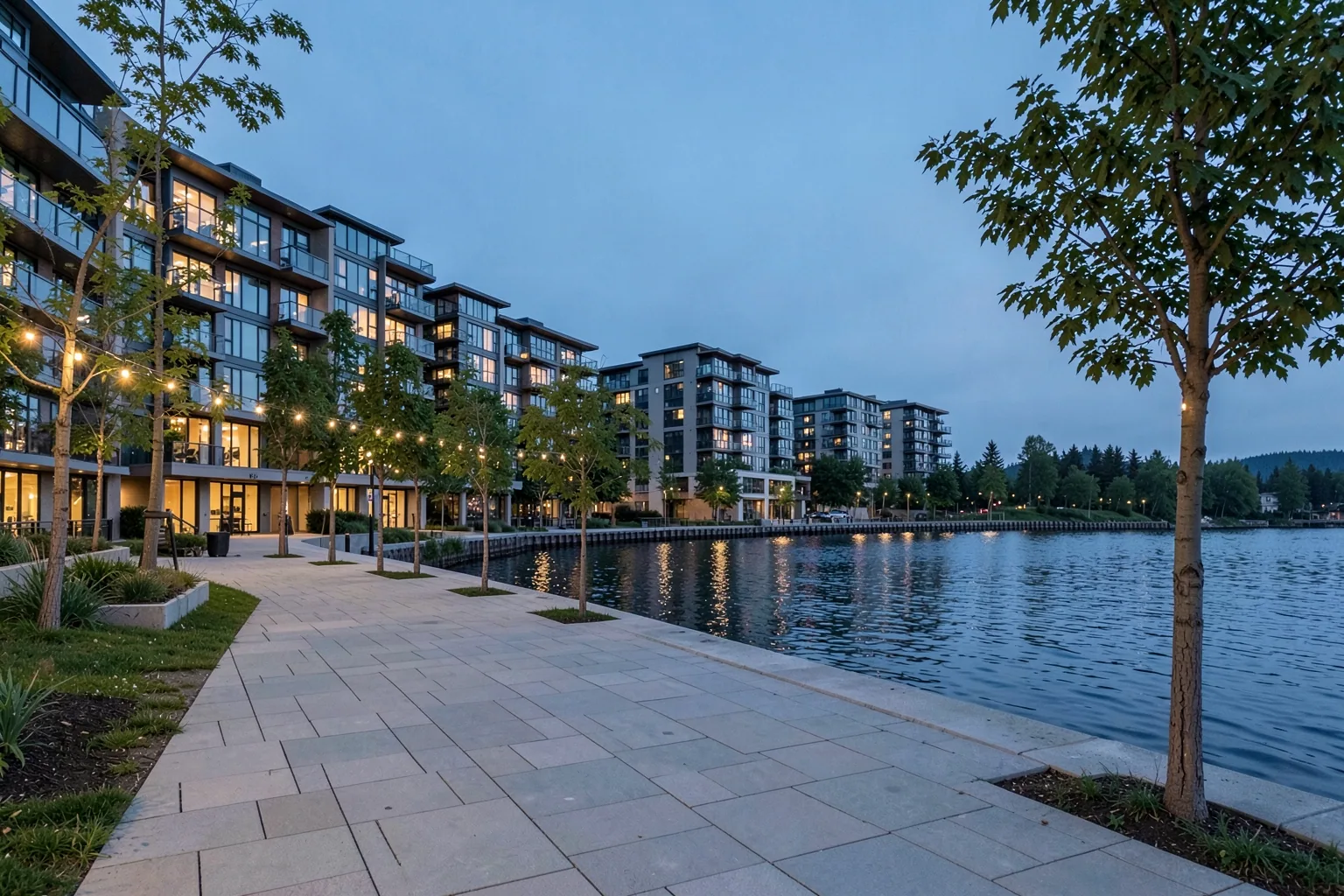
Vancouver Waterfront condominium
Many residences marketed around the Vancouver Waterfront are primarily river-view homes in a walkable district rather than parcels conveying private Columbia River shoreline. The value tends to concentrate in elevation and floor, unit position and corner exposure, the view corridor, building quality and amenities, walkability to the promenade and restaurants, and lock-and-leave ownership. For a condominium, it is worth separating the value of the view and location from ownership of any actual shoreline, and remembering that future development nearby can affect a view’s permanence.
True Columbia River frontage
A detached parcel that reaches the river is a different asset. Value concentrates in the frontage itself, the practical access to and usability of the shoreline, privacy, scarcity, the view, and any dock or moorage potential where it is legally available. It also carries the considerations that frontage brings with it, from flood and erosion exposure to shoreline regulation.
Elevated river-view estate
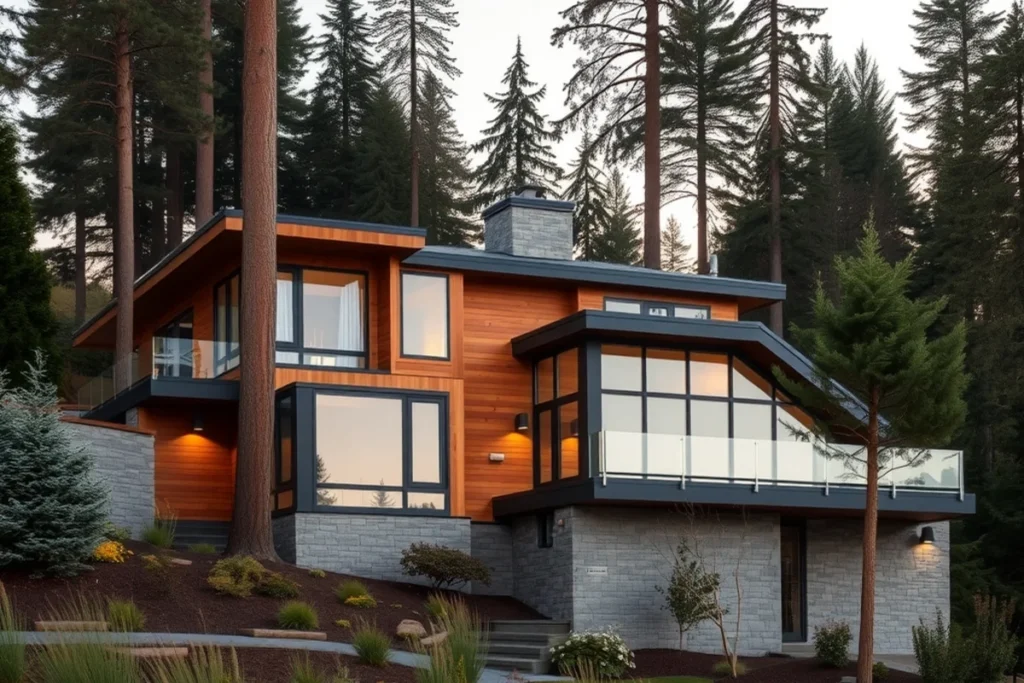
An elevated site along the Columbia River and Evergreen Highway often trades direct shoreline contact for a broad, protected panorama. Value concentrates in the view and its permanence, privacy, lot and architectural quality, and generally lower direct shoreline exposure. Two houses that both advertise “Columbia River views” can, on inspection, prove to be fundamentally different assets.
The same discipline applies elsewhere in the county. A Camas home that overlooks a lake is not “lakefront” unless the parcel and its documents say so; our analysis of the Camas view premium takes up that distinction in more depth. Around Ridgefield’s waterways and natural areas, a view of or proximity to water is not the same as fee-simple waterfront ownership. The label on the listing is a lead to verify, not a conclusion.
What Can Reduce a Waterfront Premium
Frontage is where buyers most often overpay, because it is easy to assume that touching the water is the whole story. It is not. A parcel can reach the river and still deliver little usable shoreline: a steep or eroding bank, shallow or obstructed water, a wetland or required shoreline buffer, a railroad or roadway separating the house from the water, public access across the beach, or the practical inability to add or replace a dock. Bulkhead and seawall condition, insurance, ongoing maintenance, and view obstruction all pull in the same direction.
Washington law adds a layer that surprises many buyers. Owning waterfront does not automatically mean owning the shoreline or the right to build on it. The state Department of Natural Resources manages tidelands, shorelands, harbor areas, and the beds of navigable waters as state-owned aquatic lands held in public trust, and separate frameworks govern shoreline development and moorage. A “private waterfront” listing phrase does not establish exclusive ownership of the beach, the submerged land, or a right to a dock. Those depend on title, the property boundary, state law, local shoreline regulation, permits, easements, and site conditions.
The single most useful idea in this section is a simple one. Frontage quantity and frontage quality are not the same thing. More linear feet of shoreline is not automatically worth more if that shoreline cannot be reached, built on, or used.
What Buyers Should Verify Before Paying the Premium
The premium for water is defensible only when the attributes behind it are confirmed. A focused review, completed inside the relevant contingency deadlines, protects the buyer from paying frontage prices for a view, or view prices for scenery that a neighbor can build away.
- Survey and property boundary, so you know where the parcel actually ends relative to the water.
- Title report and any recorded easements, access rights, or shared-use agreements.
- Shoreline ownership and the exact scope of any deeded or community access.
- Dock or moorage rights and existing dock permits, rather than an assumption that a dock may be built or replaced.
- Applicable Shoreline Master Program restrictions and shoreline buffers.
- FEMA flood-zone information, base flood elevation, and any history of prior flooding.
- Bank stability, erosion history, and the condition of any bulkhead or seawall.
- An actual insurance quote, obtained early, since flood and hazard coverage can materially change the cost of ownership.
- HOA or condominium documents, including any special assessments, where applicable.
- Future-development and view-obstruction risk from neighboring parcels or vegetation.
- Comparable sales carrying genuinely equivalent water attributes, not merely a nearby address.
The insurance quote and the review of legal rights deserve particular emphasis, and both belong before the contingency deadlines rather than after. This is educational guidance rather than legal, engineering, insurance, or tax advice; each of those reviews belongs with the appropriate licensed professional. The Waterfront & Acreage Buyer’s Guide covers the broader diligence process for these properties.
What Sellers Need to Understand About Pricing
The mirror image of the buyer’s question falls to the seller. A property should not be priced simply because a nearby home also says “waterfront” or “river view.” Those words describe a marketing category, not a matched comparable.
A credible price is built from properties that align on the attributes that actually drive value: the water body, the amount and usability of frontage, the nature of access and dockability, elevation and view quality, flood exposure, property type, location, and construction quality. Judged this way, a house a few blocks closer can be a worse comparable than one slightly farther away that shares the same bundle of water-related characteristics. A nearby illustration from Washington makes the point at the assessment level: the King County Assessor’s mass-appraisal model has historically valued true lake frontage separately from lake-access rights, treating them as distinct contributors rather than one interchangeable “on the water” category. That is a King County mass-appraisal example rather than Clark County sales data, but the principle carries: frontage and access are not the same line item, and neither is a view.
The Bottom Line
Waterfront, water access, and water view are best treated as three separate real-estate attributes rather than three phrasings of one idea. A buyer should establish exactly which of them a property includes before agreeing to pay a premium for any of them. A seller should build value from comparable properties carrying the same combination of rights, access, and amenities, not from a shared adjective.
For distinctive Clark County properties, particularly along the Columbia River, the difference between “waterfront” and “water view” is often the first distinction worth making. It changes the comparable set, the diligence required, and ultimately the price a buyer should be willing to defend.
A note on scope
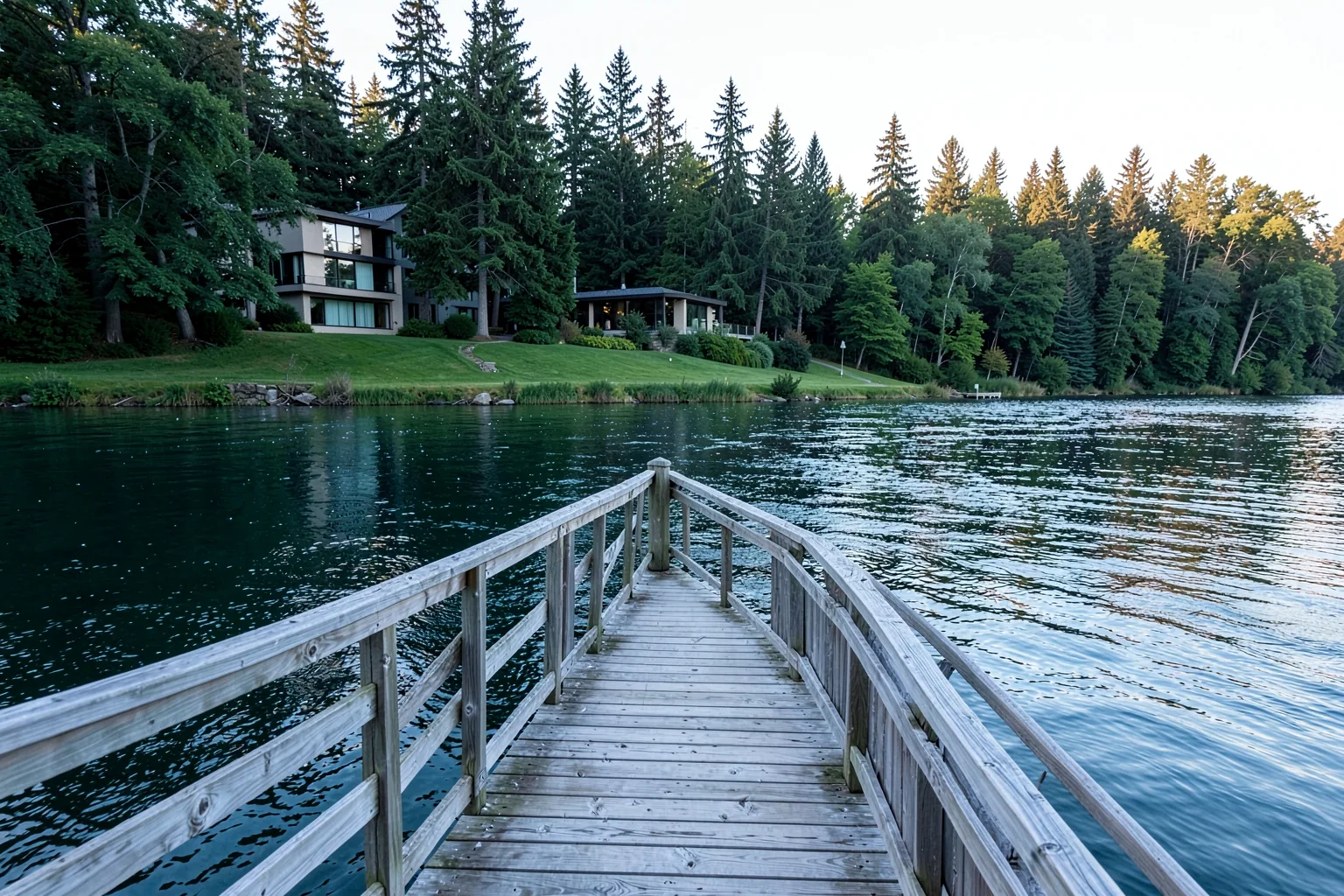
This article is educational and does not provide legal, engineering, insurance, appraisal, or tax advice. Shoreline rights, dock and moorage rights, flood exposure, and permissible improvements depend on title, property boundaries, Washington state law, local shoreline regulation, permits, easements, and site-specific conditions, and should be confirmed with the appropriate licensed professionals. Research figures cited here describe other markets and time periods and are not Clark County sales data. Photography is representative Pacific Northwest imagery and does not depict a specific property or listing unless expressly identified.
Verify It Yourself · Sources & Records
- Washington DNR — Aquatic Lands and RCW 79.105 on state-owned tidelands, shorelands, and beds of navigable waters.
- Washington Department of Ecology — the Shoreline Management Act and local Shoreline Master Programs.
- FEMA Flood Map Service Center — flood zones and base flood elevations.
- Clark County property research and records for parcel, boundary, and permit history.
- Zillow Research (2018) on the national waterfront premium and its market-by-market variation.
Related Reading
Vancouver Waterfront Living: Condos, Views, and Access
How the waterfront district’s value is built from position, views, and location rather than private shoreline.
Camas Luxury Homes: A Hedonic Analysis of the View Premium
A closer look at how view quality translates into value in one Clark County submarket.
Considering a waterfront or view property in Clark County?
The difference between waterfront, water access, and water view can change the comparable set, the diligence required, and the price worth defending. For distinctive properties along the Columbia River and across Clark County, a conversation about which attributes a property actually conveys is the right place to begin.